Compound interest is interest earning interest. It's the quiet engine behind every retirement account — and the reason starting early beats starting big.
Simple vs compound
With simple interest, you earn a fixed amount on your original deposit each year. With compound interest, each year's interest is added to your balance, so next year you earn interest on a larger amount. The growth isn't a straight line — it curves upward, gently at first, then steeply.
A quick example
Put $10,000 into an account earning 7% a year. After year one you have $10,700. In year two you earn 7% on $10,700, not just the original $10,000 — so you gain $749 instead of $700. That extra $49 is the compounding. It sounds trivial. Over 30 years, it turns $10,000 into roughly $76,000 — and you only deposited $10,000.
Why time beats amount
Because the curve steepens over time, the early years quietly do the heaviest lifting. Someone who invests $200/month from age 25 to 35 and then stops often ends up ahead of someone who starts at 35 and invests for thirty straight years — despite contributing far less. The first investor simply gave compounding more time to work.
What affects how much you get
- Rate of return — small differences compound into large gaps over decades.
- Time — the single most powerful lever, and the one you can't get back.
- Compounding frequency — monthly compounding edges out annual.
- Regular contributions — adding steadily supercharges the effect.
See it for your own savings
Our compound interest calculator plots the year-by-year curve so you can watch the snowball form and test different rates and contributions. Compounding at a steady rate is a model, though — real shares do not grow in a smooth line. The portfolio correlation and risk calculator shows what actual US stocks did month by month, including how far they fell in past crashes.
The rule of 72: a quick mental shortcut
A handy way to grasp compounding without a calculator is the rule of 72. Divide 72 by your annual interest rate, and the answer is roughly how many years it takes your money to double. At 8% a year, for example, your money doubles in about nine years (72 ÷ 8 = 9); at 6%, it takes about twelve years. This simple trick shows why even small differences in rate have such a large effect over a lifetime of saving.
How compounding frequency changes your returns
Compound interest can be calculated yearly, quarterly, monthly or even daily, and the more often it compounds, the slightly faster your money grows — because each round of interest starts earning its own interest sooner. The difference between annual and monthly compounding is modest over one year, but across decades it adds up. When comparing savings accounts or investments, it's worth checking not just the rate but how often interest is compounded.
Why starting early matters more than starting big
The single most powerful factor in compounding is time. Because interest builds on interest, the earliest contributions have the longest runway to grow and end up contributing the most to your final total. Someone who invests a modest amount in their twenties can easily finish ahead of someone who invests far more but starts in their forties. If you take one thing from compounding, let it be this: the best time to start was years ago, and the second-best time is now.
Sources. For what inflation has actually done to purchasing power, and for how fees erode compounding, see the primary sources below.
US Bureau of Labor Statistics — CPI inflation calculator · SEC — how fees and expenses affect your portfolio
Where the money actually comes from
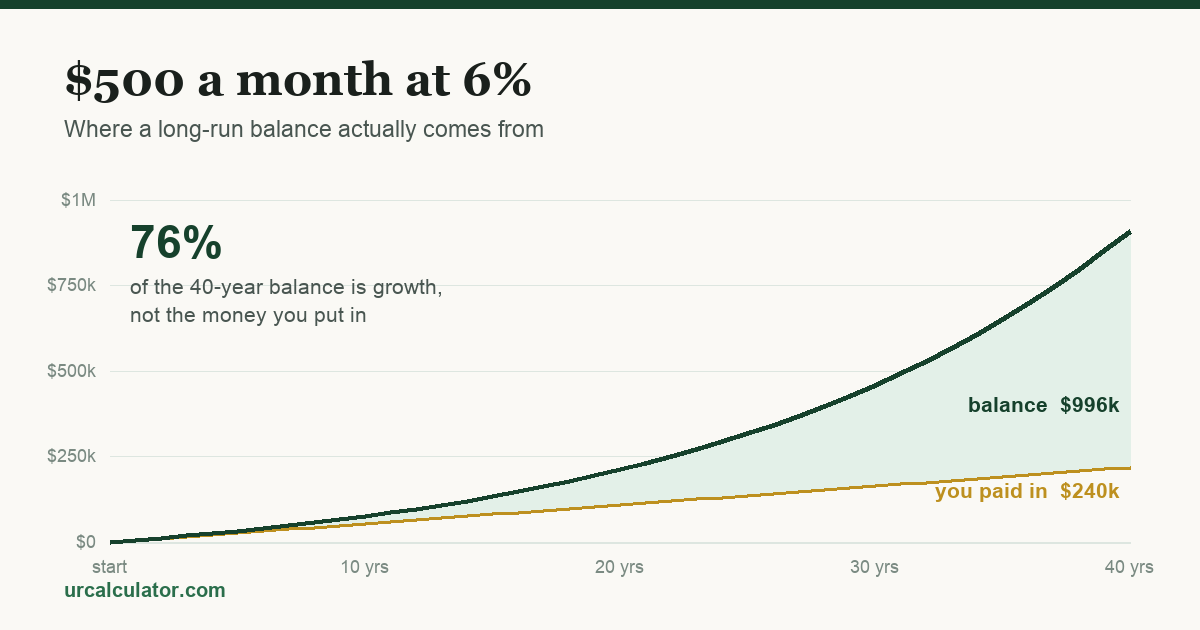
It helps to see the split. Put $500 a month into an account paying 6%, and after thirty years you will have contributed $180,000 of your own money. The balance will be roughly $502,000. Everything above your $180,000 is compounding.
| After | You put in | Balance | Growth’s share |
|---|---|---|---|
| 10 years | $60,000 | about $82,000 | 27% |
| 20 years | $120,000 | about $232,000 | 48% |
| 30 years | $180,000 | about $502,000 | 64% |
| 40 years | $240,000 | about $996,000 | 76% |
Read the last column downward. In the first decade you are doing nearly all the work. By the fourth, the account is. That crossover is the entire argument for starting early, and it is why the last ten years of a long run add more than the first twenty.
Inflation is the part that is usually left out
A balance that grows at 6% while prices rise at 2% is really growing at about 4%. The $996,000 above, forty years out, buys roughly what $451,000 buys today.
That is not a reason to be discouraged — it is a reason to compare against the right benchmark. If a savings account pays 2% and inflation runs at 2%, you are not making money; you are standing still with extra steps. The number worth watching is the real return, which is roughly the rate minus inflation.
What it looks like working against you
Compounding does not care which direction it runs. Carry $5,000 on a credit card at 20% and pay only the minimum, and the same mechanism that builds a retirement fund quietly takes one apart — interest charged on interest, month after month, with the balance barely moving.
This is why paying down high-interest debt is so often the better investment. A 20% card is a guaranteed 20% return, tax-free, with no market risk attached. Very little else on offer comes close.
What it looks like on a real stock
Compounding on a spreadsheet is smooth. On a real holding it is not. Our breakdown of the Apple stock 10 year return shows the same arithmetic applied to an actual price history — including the two years that produced most of the gain and the three falls of more than 20% you would have had to sit through.
Frequently asked questions
What is the difference between simple and compound interest?
Simple interest is calculated only on your original amount, while compound interest is calculated on your original amount plus all the interest already earned. Compounding is what makes long-term growth accelerate over time.
How often does compound interest get added?
It depends on the account or investment — it can compound annually, quarterly, monthly or daily. More frequent compounding grows your money slightly faster because interest starts earning its own interest sooner.
How can I calculate compound interest on my savings?
You can use our compound interest calculator to see year-by-year growth for your own starting amount, contributions and rate.
This article is general information, not financial, tax, or medical advice. See our disclaimer.
Who made this. urcalculator.com is built and maintained by Hariom J., who is not an accountant, tax preparer or financial adviser. Every figure on this page is taken from a primary source — the government departments that publish the rules — and cited, so you can check it rather than take anyone’s word for it. That is the standard this site is held to instead of professional authority. For a decision that turns on your own circumstances, speak to someone qualified who knows them. See how these pages are built and our disclaimer.