On a $100,000 salary in 2026, Canadians keep between $67,885 and $76,420 after income tax, CPP and EI — lowest in Quebec, highest in Nunavut, a gap of $8,534 on identical pay. The tables below give take-home pay on $60,000, $80,000, $100,000 and $120,000 in all 13 provinces and territories, sorted highest to lowest. Every number here was produced by our own Canada take-home pay calculator.
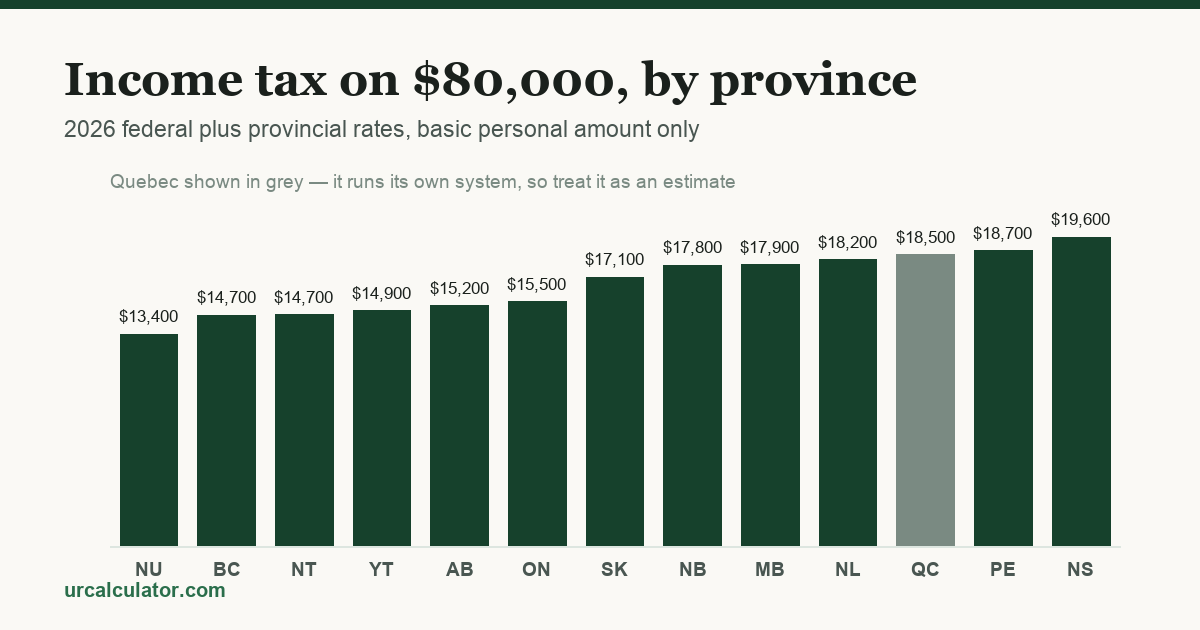
How to read these tables. “Take-home pay” is what is left after income tax and CPP and EI come off. “Income tax” is federal plus provincial or territorial income tax — and for Ontario it also includes the Ontario Health Premium and the Ontario surtax, which many free calculators leave out. All figures are 2026 estimates for employment income with the basic personal amount only. These are estimates for planning, not tax advice.
Take-home pay in every province, 2026
Sorted by what you keep on $100,000, highest first. Two results surprise people: Nunavut, not Alberta, gives the highest take-home pay at every salary tested, and British Columbia beats Alberta at all four rungs.
| Province / territory | $60,000 | $80,000 | $100,000 | $120,000 |
|---|---|---|---|---|
| Nunavut | $48,539 | $62,065 | $76,420 | $90,630 |
| British Columbia | $47,682 | $61,079 | $75,287 | $88,884 |
| Northwest Territories | $47,689 | $60,917 | $74,955 | $88,497 |
| Yukon | $47,579 | $60,733 | $74,692 | $88,657 |
| Alberta | $47,481 | $60,487 | $74,248 | $88,048 |
| Ontario | $47,117 | $60,080 | $73,959 | $87,165 |
| Saskatchewan | $46,142 | $58,644 | $71,910 | $85,210 |
| Manitoba | $45,573 | $58,029 | $71,246 | $83,673 |
| New Brunswick | $45,765 | $57,963 | $70,932 | $83,606 |
| Newfoundland & Labrador | $45,387 | $57,481 | $70,214 | $82,854 |
| Prince Edward Island | $45,179 | $57,031 | $69,485 | $81,823 |
| Nova Scotia | $44,470 | $56,165 | $68,581 | $80,880 |
| Quebec † | $44,650 | $55,906 | $67,885 | $79,266 |
† Quebec estimate. Quebec residents pay QPP and QPIP rather than CPP and EI, and receive a federal tax abatement, none of which is modelled here.
Take-home pay on a $60,000 salary by province (2026)
Take-home runs from $44,470 in Nova Scotia to $48,539 in Nunavut — a spread of $4,069 on the same salary. Effective tax rates range from 11.9% to 18.7%.
| Province / territory | Take-home pay | Income tax | Effective rate |
|---|---|---|---|
| Nunavut | $48,539 | $7,122 | 11.9% |
| Northwest Territories | $47,689 | $7,971 | 13.3% |
| British Columbia | $47,682 | $7,979 | 13.3% |
| Yukon | $47,579 | $8,081 | 13.5% |
| Alberta | $47,481 | $8,180 | 13.6% |
| Ontario | $47,117 | $8,544 | 14.2% |
| Saskatchewan | $46,142 | $9,518 | 15.9% |
| New Brunswick | $45,765 | $9,895 | 16.5% |
| Manitoba | $45,573 | $10,087 | 16.8% |
| Newfoundland & Labrador | $45,387 | $10,273 | 17.1% |
| Prince Edward Island | $45,179 | $10,481 | 17.5% |
| Quebec † | $44,650 | $11,010 | 18.4% |
| Nova Scotia | $44,470 | $11,191 | 18.7% |
Take-home pay on an $80,000 salary by province (2026)
The spread widens to $6,158. Ontario sits sixth here, behind Alberta, once the $750 Ontario Health Premium is counted — leave it out and Ontario appears to rank fourth. For the band-by-band build-up at this salary, see how much tax on an $80,000 salary in Ontario.
| Province / territory | Take-home pay | Income tax | Effective rate |
|---|---|---|---|
| Nunavut | $62,065 | $12,366 | 15.5% |
| British Columbia | $61,079 | $13,351 | 16.7% |
| Northwest Territories | $60,917 | $13,513 | 16.9% |
| Yukon | $60,733 | $13,698 | 17.1% |
| Alberta | $60,487 | $13,943 | 17.4% |
| Ontario | $60,080 | $14,351 | 17.9% |
| Saskatchewan | $58,644 | $15,786 | 19.7% |
| Manitoba | $58,029 | $16,401 | 20.5% |
| New Brunswick | $57,963 | $16,467 | 20.6% |
| Newfoundland & Labrador | $57,481 | $16,950 | 21.2% |
| Prince Edward Island | $57,031 | $17,399 | 21.7% |
| Nova Scotia | $56,165 | $18,265 | 22.8% |
| Quebec † | $55,906 | $18,524 | 23.2% |
Take-home pay on a $100,000 salary by province (2026)
At six figures the gap between the best and worst jurisdiction reaches $8,534 — about seven weeks of net pay. Effective rates run from 17.8% to 26.3%.
| Province / territory | Take-home pay | Income tax | Effective rate |
|---|---|---|---|
| Nunavut | $76,420 | $17,811 | 17.8% |
| British Columbia | $75,287 | $18,943 | 18.9% |
| Northwest Territories | $74,955 | $19,275 | 19.3% |
| Yukon | $74,692 | $19,539 | 19.5% |
| Alberta | $74,248 | $19,982 | 20.0% |
| Ontario | $73,959 | $20,272 | 20.3% |
| Saskatchewan | $71,910 | $22,320 | 22.3% |
| Manitoba | $71,246 | $22,985 | 23.0% |
| New Brunswick | $70,932 | $23,298 | 23.3% |
| Newfoundland & Labrador | $70,214 | $24,016 | 24.0% |
| Prince Edward Island | $69,485 | $24,745 | 24.7% |
| Nova Scotia | $68,581 | $25,650 | 25.6% |
| Quebec † | $67,885 | $26,345 | 26.3% |
Take-home pay on a $120,000 salary by province (2026)
Take-home ranges from $79,266 in Quebec to $90,630 in Nunavut, a spread of $11,364. This is the rung where Ontario’s surtax starts to bite. The surtax is charged on your provincial tax rather than on your income, so it climbs far faster than your pay does: on these assumptions it is $0 at $60,000 and $80,000, about $50 at $100,000, then about $578 at $120,000. Yukon also overtakes the Northwest Territories at this income, having sat below it at all three lower salaries.
| Province / territory | Take-home pay | Income tax | Effective rate |
|---|---|---|---|
| Nunavut | $90,630 | $23,601 | 19.7% |
| British Columbia | $88,884 | $25,346 | 21.1% |
| Yukon | $88,657 | $25,574 | 21.3% |
| Northwest Territories | $88,497 | $25,734 | 21.4% |
| Alberta | $88,048 | $26,183 | 21.8% |
| Ontario | $87,165 | $27,066 | 22.6% |
| Saskatchewan | $85,210 | $29,021 | 24.2% |
| Manitoba | $83,673 | $30,557 | 25.5% |
| New Brunswick | $83,606 | $30,624 | 25.5% |
| Newfoundland & Labrador | $82,854 | $31,377 | 26.1% |
| Prince Edward Island | $81,823 | $32,407 | 27.0% |
| Nova Scotia | $80,880 | $33,350 | 27.8% |
| Quebec † | $79,266 | $34,965 | 29.1% |
Why the same salary leaves you with different take-home pay
Federal tax is identical everywhere — 14% on the first $58,523, rising to 33% above $258,482, with a basic personal amount of up to $16,452. What changes is the provincial layer: each province and territory sets its own brackets and its own basic personal amount. Nunavut opens at 4% and Alberta has the largest basic personal amount in the country at $22,769, while Quebec and the Atlantic provinces charge more. Alberta’s advantage is real but concentrated at the bottom and the very top, which is why British Columbia’s lower opening rates leave a BC earner ahead at every salary on this page. The difference between marginal and effective rate matters here too — we explain it in marginal vs effective tax rate.
CPP and EI also cap out, which flattens the picture at higher incomes: both stop coming off your pay partway through the year, so a bigger salary is not deducted proportionally more.
How these figures were calculated
Every figure on this page was produced by running the site’s own 2026 tax engine — the same code behind our Canada income tax calculator — not copied from any other site.
Assumptions: employment income only; the basic personal amount and no other credits or deductions; no RRSP contributions; a full year of employment; 2026 federal and provincial or territorial brackets; and CPP, CPP2 and EI charged at 2026 rates up to the 2026 maximums. Ontario figures include the Ontario Health Premium and the Ontario surtax.
What is included: the tax treatment of your own contributions. The base portion of CPP and all EI generate a non-refundable tax credit, while the enhanced portion of CPP and CPP2 are deducted from income before tax is calculated. Leaving these out overstates tax by roughly $900 to $1,900 depending on income and province.
What we do not model: Quebec’s QPP, QPIP and federal abatement. Your own credits and deductions will move these numbers.
Rates come from: CRA current-year federal and provincial/territorial tax rates and brackets · CRA CPP contribution rates, maximums and exemptions · CRA EI premium rates and maximums · Ontario Health Premium (Government of Ontario) · Revenu Québec income tax rates.
Income tax is only half of what your province takes. Sales tax varies just as widely — from 5% in Alberta to 15% in the Atlantic provinces — and you pay it on almost everything you buy. Our GST, HST and PST calculator covers all thirteen.
See your exact number
These tables assume a plain salary with the basic personal amount. Your real result depends on your credits, deductions, RRSP contributions and pay frequency: If some of that income will come from a registered plan later, the RRSP withdrawal tax calculator shows what it costs to take out, province by province.
- Canada Take-Home Pay (Paystub) Calculator — enter your salary and province to see what lands in your bank account each pay period.
- Canada Income Tax Calculator — a 2026 breakdown of federal tax, provincial tax, CPP and EI.
This article is general information, not financial, tax, or medical advice. See our disclaimer.
Who made this. urcalculator.com is built and maintained by Hariom J., who is not an accountant, tax preparer or financial adviser. Every figure on this page is taken from a primary source — the government departments that publish the rules — and cited above, so you can check it rather than take anyone’s word for it. That is the standard this site is held to instead of professional authority. For a decision that turns on your own circumstances, speak to someone qualified who knows them. See how these pages are built and our disclaimer.