
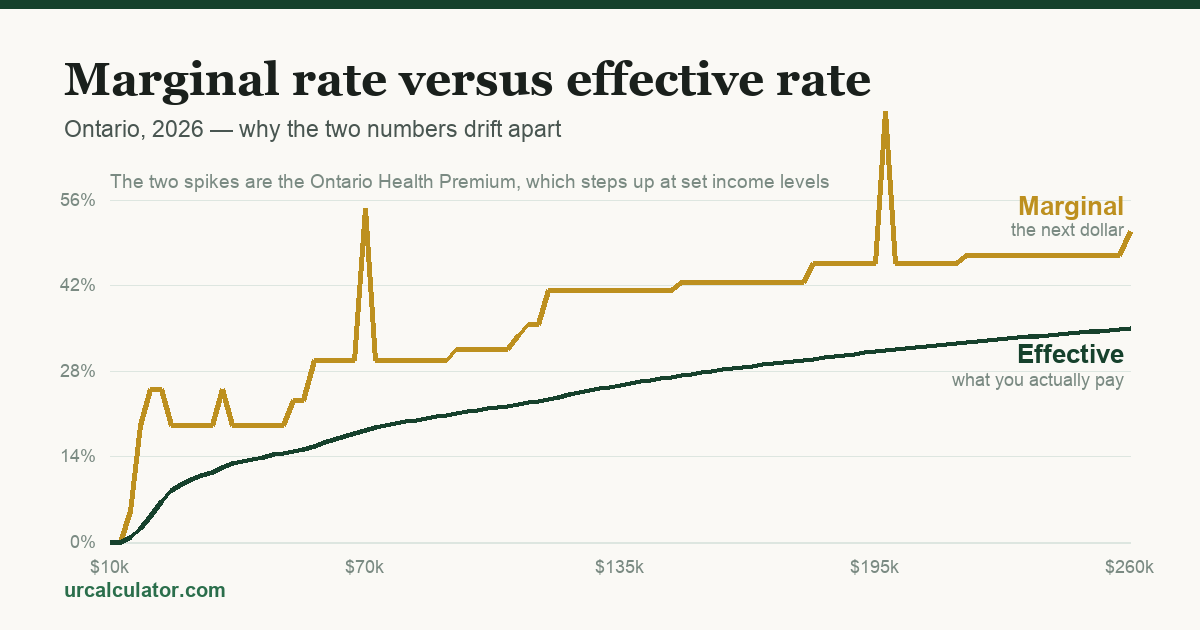
Your marginal rate is the tax on your next dollar. Your effective rate is the tax on your whole income. They're almost never the same — and confusing them leads to genuinely bad money decisions.
A stack of buckets
Both the US and Canada use a progressive system. Picture your income poured into a stack of buckets. The first bucket is taxed at the lowest rate; only the overflow into the next bucket is taxed at the next rate, and so on. No single dollar is ever taxed more than once, and reaching a higher bracket only affects the dollars in that bracket.
Marginal rate
Your marginal rate is the rate on the top bucket your income reaches. If a US single filer's last dollars fall in the 22% bracket, their marginal rate is 22%. This is the number that matters for decisions at the margin: "If I earn $1,000 more, how much do I keep?" or "If I deduct $1,000, how much do I save?"
Effective rate
Your effective rate is total tax divided by total income — the true average. Because most of your income was taxed in the lower buckets, this is always lower than your marginal rate. A US single filer earning $80,000 might have a 22% marginal rate but an effective rate closer to 12%.
An illustration you can check with a calculator
Real bracket tables have credits and thresholds bolted on, which obscures the mechanism. So here is an imaginary country with two bands — these are made-up numbers chosen only to show the arithmetic, not any real jurisdiction's rates.
Freedonia taxes the first $50,000 of income at 10%, and everything above $50,000 at 30%.
Someone earning $80,000 pays 10% on the first $50,000, which is $5,000, plus 30% on the remaining $30,000, which is $9,000. Total tax: $14,000.
- Their marginal rate is 30% — the rate that would apply to one more dollar of income.
- Their effective rate is $14,000 ÷ $80,000 = 17.5% — what they actually paid on the whole amount.
Now give them a $10,000 raise. The extra $10,000 is taxed at 30%, so $3,000 more tax and $7,000 more in their pocket. Their marginal rate hasn't changed at all — they were already in the top band. Their effective rate creeps up from 17.5% to 18.9%, because a larger share of their income now sits in the expensive band. Notice what didn't happen: the first $50,000 was not retroactively re-taxed, and their take-home did not fall.
Why the two numbers drift apart
The gap between your marginal and effective rates is essentially a measure of how much of your income is sheltered in the cheap bands below you. That has two practical consequences.
Someone whose income sits just barely into a new bracket has a large gap — almost all of their income was taxed at lower rates, so the headline marginal number badly overstates what they pay. Someone earning many times the threshold has a narrow gap, because most of their income really is being taxed at the top rate. The same is true across a career: the gap tends to be widest for middle earners and narrows as income rises.
Personal amounts, standard deductions and non-refundable credits widen the gap further, since they carve out a slab of income that is effectively taxed at nothing at all.
Which number to use when
| Question | Use this rate |
|---|---|
| Should I make this deductible contribution? | Marginal |
| Is a side gig worth it after tax? | Marginal |
| What share of my pay goes to tax overall? | Effective |
| Comparing total tax burden between years | Effective |
The rate that really governs your decisions
Here's the wrinkle most explanations skip. The bracket rate printed in the tax tables is rarely the full cost of your next dollar, because income tax isn't the only thing that responds to earning more.
Payroll contributions sit on top of it until you hit their annual ceilings. State or provincial tax stacks on top of federal. And income-tested benefits and credits — child benefits, health or housing subsidies, tuition and retirement credits, and similar programs on both sides of the border — are typically reduced as income rises. Each of those clawbacks acts like additional tax on the same dollar.
Add them together and you get your true marginal rate, which can be meaningfully higher than the bracket you're "in" — occasionally dramatically so over a narrow band of income where several phase-outs overlap. This is why two people in the same statutory bracket can face very different real costs on an extra shift, and it's the honest answer to "is the overtime worth it?" A bracket table alone can't tell you; it only knows about one of the several things happening to that dollar.
Deductions and credits pull on different levers
Once the two rates are clear, a related distinction falls into place.
A deduction reduces the income you're taxed on, so it saves you tax at your marginal rate — the same deduction is worth more to a higher earner. A credit reduces the tax itself. In Canada most non-refundable credits are applied at the lowest bracket rate regardless of what you earn, which is precisely why they're worth the same to almost everyone. Knowing which of the two you're looking at tells you immediately whether your marginal rate is relevant to the decision or not.
Why your payslip may suggest a third number entirely
Neither rate is what you'll see withheld from a single paycheque. Employers withhold using formulas that annualise whatever you were paid this period, so anything irregular distorts it.
A bonus is the classic example. Paid in one lump, it can be withheld as though you earn at that elevated rate all year, so the deduction looks brutal and people conclude bonuses are "taxed higher." They aren't. It's a withholding artefact, and it reconciles when you file — you either get the excess back as a refund or, if withholding was light, you owe the difference. The tax you actually owe is settled on the return, not on the payslip.
The same effect appears if you change jobs mid-year, work several jobs at once, or have a period without income. In each case the withholding is a forecast, and the annual calculation is the truth.
A quick sanity check on any tax claim
If you see a claim that someone "pays 50% in tax," ask which rate is meant. A top marginal rate near 50% is entirely plausible in several jurisdictions; an effective rate of 50% on employment income is much harder to arrive at, because all the lower bands were traversed first. Most arguments about tax burden are really arguments between two different numbers, and naming which one you're using resolves them faster than any further debate.
See both for your income
Our income tax calculators show your marginal and effective rates side by side, with the full bracket-by-bracket breakdown.
Sources. Canadian bracket thresholds are published by the Canada Revenue Agency; US brackets by the IRS.
CRA — federal and provincial income tax rates · IRS — federal income tax rates and brackets
This article is general information, not financial, tax, or medical advice. See our disclaimer.
Who made this. urcalculator.com is built and maintained by Hariom J., who is not an accountant, tax preparer or financial adviser. Every figure on this page is taken from a primary source — the government departments that publish the rules — and cited, so you can check it rather than take anyone’s word for it. That is the standard this site is held to instead of professional authority. For a decision that turns on your own circumstances, speak to someone qualified who knows them. See how these pages are built and our disclaimer.